
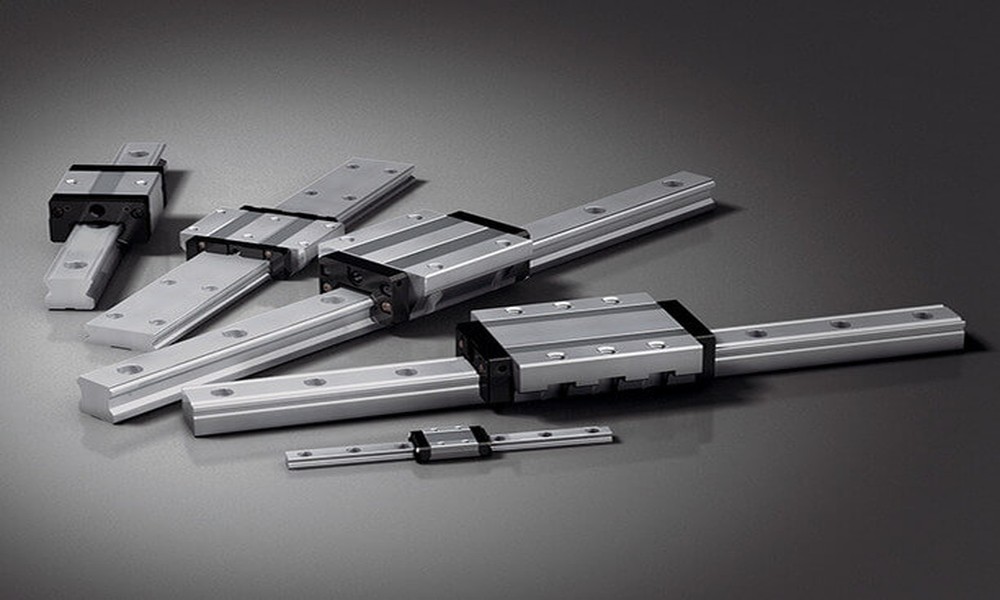
In industrial applications that require high precision-such as CNC machinery, automation systems, robotics, or production line equipment-the LM Guide plays a crucial role in linear motion systems. One of the increasingly popular technologies in this field is the SRS LM Guide (Caged Ball Miniature Guide), which is designed to reduce friction and enhance operational stability. Meanwhile, conventional steel-type LM Guides remain a widely used traditional standard. This article will clearly explain the differences to help you choose the most suitable system for your application.
Fundamental Structure
The key difference between the SRS LM Guide (Caged Ball Miniature Guide) and the conventional steel-type LM Guide lies in the arrangement of the rolling elements (balls).
In a standard steel LM Guide, the balls are in direct contact with each other during movement. This direct contact creates friction between the balls, which leads to heat buildup and long-term wear over time.
In contrast, the SRS LM Guide (Caged Ball Miniature Guide) uses a “Caged Ball” structure, where a cage is installed to evenly space and organize the balls. This prevents direct ball-to-ball contact, resulting in smoother motion and more efficient reduction of energy loss caused by friction.
Clearly Different Smoothness
When it comes to motion performance, the SRS LM Guide (Caged Ball Miniature Guide) delivers a noticeably smoother, softer, and more consistent movement compared to conventional steel-type LM Guides.
This is because the caged ball structure reduces internal impact and friction, leading to lower resistance during motion.
On the other hand, standard steel LM Guides are still suitable for general applications, but they generate higher friction-especially in high-speed operations or applications with frequently changing loads. This can sometimes result in vibration or less stable movement.
Service Life and Wear Resistance
Another major advantage of the SRS LM Guide is its longer service life. Since the balls do not rub directly against each other, internal wear is significantly reduced. This allows the system to operate continuously for longer periods without frequent maintenance or replacement.
In contrast, conventional steel LM Guides, although mechanically strong, tend to experience gradual wear due to ball-to-ball contact. Over time, this can reduce positioning accuracy and may require earlier component replacement.
Maintenance and Operational Stability
The SRS LM Guide is designed for reduced maintenance requirements. The caged ball system helps distribute load more evenly, allowing lubrication to work more effectively and minimizing the accumulation of metal debris inside the rail. Meanwhile, standard steel LM Guides typically require more frequent lubrication and maintenance to maintain consistent performance, especially in dusty environments or continuous heavy-duty operation.
Speed and Precision in Operation
In modern automation systems, speed and precision are critical. The SRS LM Guide supports high-speed movement effectively because it reduces friction and vibration, resulting in improved positioning accuracy. Standard steel LM Guides are still suitable for general applications, but at higher speeds they may generate more heat and resistance, which can slightly reduce precision compared to caged ball systems.
Suitable Applications for Each Type
The SRS LM Guide (Caged Ball Miniature Guide) is ideal for high-precision applications such as compact CNC machines, high-speed packaging equipment, industrial robots, and automated systems that require continuous stability and accuracy. Meanwhile, conventional steel LM Guides are better suited for basic applications, general structural systems, or machinery that does not require extremely high speed or precision, offering a more cost-effective solution.
The SRS LM Guide (Caged Ball Miniature Guide) offers key advantages in terms of smoother motion, higher precision, longer service life, and lower maintenance requirements. It is therefore well-suited for industrial applications that demand high performance and long-term operational stability. In contrast, conventional steel-type LM Guides remain a cost-effective option, making them suitable for basic applications or systems that are less complex. The selection of an appropriate LM Guide should be based on the nature of the application, budget, and required level of precision to ensure the linear motion system operates with maximum efficiency over the long term.
I.N.B supplies the SRS LM Guide (Caged Ball Miniature Guide) or รังลูกปืน LM Guide SRS along with a wide range of cage ball products, designed to support various industrial applications. This allows users to choose the most suitable solution that best meets their specific operational requirements.