
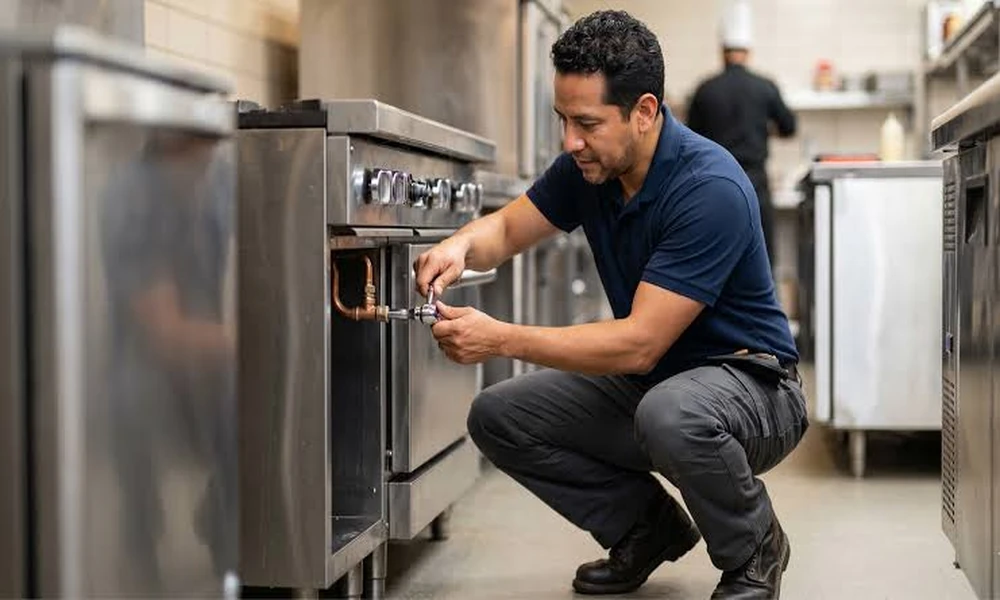
A domestic appliance failing is an inconvenience. A retail display chiller failing at eight on a Saturday morning is lost stock, a food safety question, an unusable display and a day of trading affected. That difference in consequence is the entire argument for a Commercial appliance maintenance program for retailers, which exists to convert unpredictable failures into scheduled visits.
Commercial Equipment Is Not Domestic Equipment
Retail refrigeration, display chillers, ice machines, commercial ovens and dishwashers are built for continuous duty and are engineered differently, larger compressors, heavier-duty components, and in many cases three-phase supply. They also run far longer hours than a household appliance and are opened hundreds of times a day. Servicing them requires technicians who work on commercial equipment specifically, and parts availability differs from the domestic market in both cost and lead time.
What a Programme Typically Covers
A structured agreement usually includes scheduled preventive visits at a defined frequency, priority response for breakdowns with a stated attendance time, cleaning of condensers and coils, checking refrigerant pressures and temperatures, inspection of seals, gaskets and door closures, electrical safety checks, calibration of thermostats and controls, and a written report after each visit. Some include a discount on parts or an allowance for minor components, and some cover labour on breakdowns within the fee.
Why Preventive Beats Reactive Here
Most commercial refrigeration failures develop over weeks. Condenser coils foul gradually until heat rejection is inadequate, seals perish, refrigerant charge drops slowly through a small leak, and fan motors draw progressively more current before seizing. A technician measuring pressures, temperatures and current draw on a schedule catches all four while they are adjustments rather than failures. Reactive maintenance catches them at the point where stock is already warming.
Response Time Is the Term That Matters
When comparing agreements, the response commitment is usually more important than the visit frequency. Establish what response time is guaranteed, whether it covers evenings and weekends when retail actually trades, what happens on public holidays, and what the escalation path is. An agreement offering a next-business-day response is of limited use to a business whose busiest trading is on a Sunday, and this is exactly the detail that goes unexamined until it is tested.
Food Safety and Temperature Records
For any retailer handling food, refrigeration is a compliance matter as much as an operational one. Temperature monitoring and record-keeping demonstrate that stock has been held safely, and a documented maintenance regime supports that position. Where equipment fails, records showing it was serviced and monitored make the difference between an incident that was managed and one that was not. Providers comparing commercial and residential appliance repair will usually offer monitoring and reporting as part of a commercial agreement.
Multi-Site Operations
A retailer with several outlets has a different problem from one with a single shop: consistency, visibility and coordination. Useful features include a single point of contact across all sites, an asset register recording every unit with its age, service history and warranty position, consolidated reporting so head office can see which sites are consuming the most maintenance, and consistent scheduling so no branch is quietly missed. That asset register is also what turns replacement planning from a series of emergencies into a budget line.
Energy Consumption Is Part of the Case
Refrigeration runs continuously and is usually among the largest electrical loads in a retail unit, which means poorly maintained equipment costs money every hour rather than only when it fails. Condenser coils coated in dust force the compressor to work harder for the same cooling. A perished door gasket admits warm humid air that must then be removed again. Low refrigerant charge reduces capacity while the unit runs longer to compensate. None of these register as faults, because the equipment still appears to work. A maintenance programme that addresses them recovers part of its own cost through the electricity bill, which is worth quantifying rather than treating as a marketing claim.
Costing It Honestly
Compare the annual programme fee against what reactive maintenance actually costs, and include the parts that fail because nothing was caught early, the emergency callout premiums, the stock written off, and the trading affected. Most retailers who run that calculation find the programme cheaper before the operational benefits are considered at all. Where it is not, that usually indicates equipment near the end of its life, which is a replacement conversation rather than a maintenance one.
What Staff Should Handle Daily
A programme works alongside in-house routines rather than replacing them. Staff should keep condenser areas clear and free of stock, clean accessible filters, wipe and check door seals, avoid overloading display units past the load line, record temperatures daily, and report any change in sound or performance immediately. Training the team to notice and report costs nothing and is the earliest warning system available.
Choosing a Provider
Ask about experience with your specific equipment types and brands, technician qualifications for refrigeration and electrical work, whether spares for your units are stocked locally, what the response commitment covers including out of hours, what reporting you receive, and how the agreement handles equipment that fails repeatedly. Assessed on those terms, a Commercial appliance maintenance program for retailers stops being an overhead and becomes the reason trading days proceed without incident.